

Continuous Code Maintenance: Strategies & Automation
Learn what continuous code maintenance is, why it matters for software health, and proven strategies to keep your codebase secure, performant, and scalable.

Your codebase is degrading right now. Dependencies are falling behind, untested code paths are multiplying, and the security vulnerabilities you don't know about are the ones that will hit production at 3 am. Most teams treat maintenance as a periodic chore, something to batch into a "tech debt sprint" every quarter. That approach stopped working the moment your codebase started changing daily (especially when AI agents start writing the bulk of your code).
Continuous code maintenance is the practice of treating the health of existing code as an ongoing, automated process rather than a scheduled event. Instead of waiting for problems to accumulate, teams that adopt continuous maintenance catch issues early, fix them incrementally, and keep their codebases in a state where shipping new features stays fast. This post breaks down what continuous maintenance looks like in practice, why it matters for engineering teams managing growing codebases, and the specific strategies that make it work.
What Is Continuous Code Maintenance?
Continuous code maintenance means integrating maintenance tasks into your regular development workflow so they happen automatically and incrementally, not in large, disruptive batches. Think of it as applying the same philosophy behind continuous integration to code health: small, frequent maintenance actions executed as part of your normal development cycle.
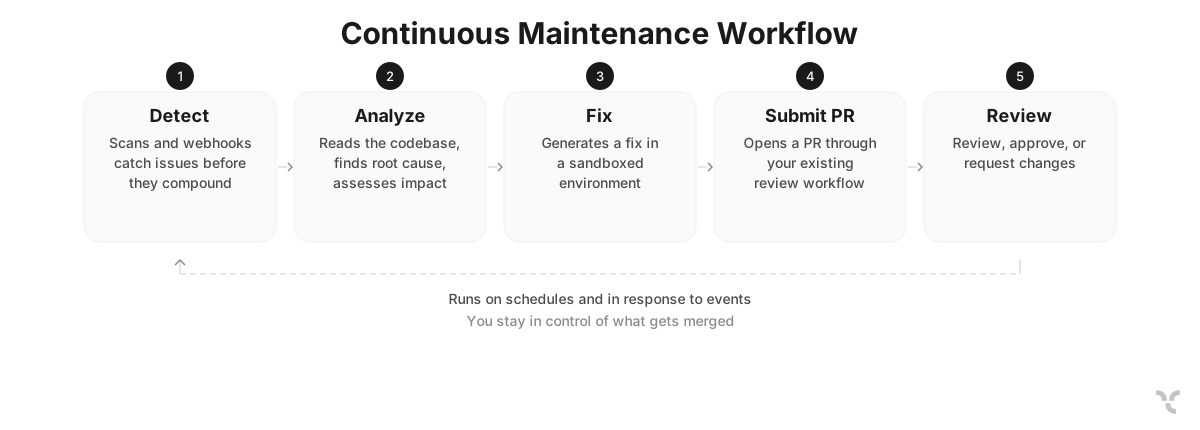
The shift is from reactive to proactive. Traditional maintenance waits for something to break, then scrambles to fix it. Continuous maintenance runs in the background, catching issues before they compound. A dependency goes stale? An automated scan flags it and opens a PR. A security vulnerability appears in a package you depend on? A scheduled check catches it within hours, not months.
This is where AI coding agents are changing the equation. Platforms like Tembo run autonomous agents on configurable schedules or in response to events, handling maintenance tasks that previously required a developer to remember, prioritize, and execute. The agent monitors your codebase, identifies what needs attention, and submits changes through your existing PR workflow, so you stay in control of what gets merged.
What continuous maintenance is NOT: It is not a replacement for thoughtful architecture decisions or a substitute for code reviews. It is the connective tissue that keeps your codebase healthy between major engineering efforts. It handles the work that everyone agrees should happen, but nobody has time to prioritize.
Why Continuous Code Maintenance Is Critical for Modern Software
The economics are stark. Studies show that 60-80% of total software costs come from maintenance, yet most teams allocate the majority of their engineering budget to new feature development. The result is predictable: technical debt accumulates silently until it slows every new feature to a crawl.
The real cost is not in the maintenance work itself. It is in the compounding effect of deferred maintenance on development velocity. Every unpatched dependency is a potential security incident. Every untested code path is a future regression. Every deprecated API call is a ticking clock. When these issues pile up, your team spends more time working around problems than building new capabilities.
Three specific ways deferred maintenance hurts your team:
- Slower feature delivery. Engineers spend time navigating workarounds for known issues instead of shipping. Onboarding new developers takes longer because the codebase has accumulated undocumented quirks.
- Increased incident frequency. Outdated dependencies and unpatched vulnerabilities create an expanding attack surface. Production incidents that trace back to "we knew about this but didn't prioritize it" erode team morale and customer trust.
- Higher context-switching costs. When maintenance is batched into sprints, engineers must context-switch away from feature work. Continuous maintenance eliminates this by running in the background, so developers stay focused on high-value work.
The teams that treat maintenance as a continuous process, not an occasional project, are the ones that sustain high shipping velocity over years rather than months.
Types of Software Maintenance Explained
Software maintenance falls into four established categories, each serving a different purpose in keeping your codebase healthy. Understanding these categories helps you decide which tasks to automate and which require human judgment.
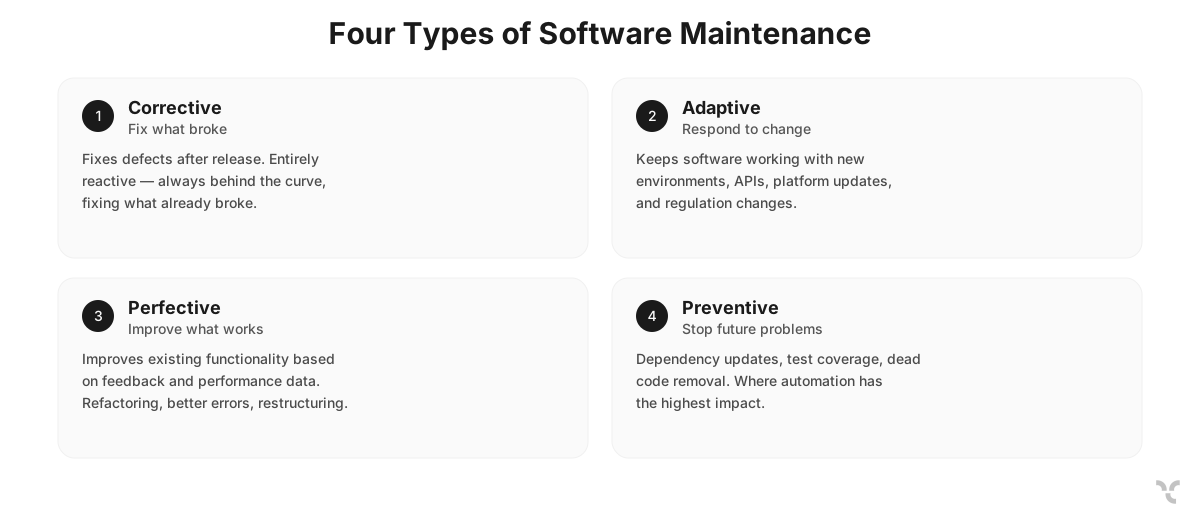
Corrective maintenance fixes defects discovered after release. This is the most familiar type: a production error appears, someone files a ticket, a developer investigates and patches the issue. The problem with corrective-only maintenance is that it is entirely reactive. You are always behind the curve, fixing what is already broken. Continuous maintenance changes this by connecting error monitoring to an automated response. When a Sentry webhook fires for a new production error, an agent can analyze the stack trace, identify the root cause, generate a fix, and open a PR before a developer has even triaged the alert.
Adaptive maintenance modifies software to work with changing environments. When your cloud provider deprecates an API version, when a new browser version breaks your frontend, or when regulatory requirements change, adaptive maintenance brings your code into compliance. Teams that automate environment monitoring catch these shifts early. Tembo's event-driven automations handle this by listening for webhooks from tools like GitHub and Sentry, then scanning the affected code and opening a PR with the necessary changes. Instead of waiting for a developer to notice the deprecation notice, the agent reacts to the event and starts the migration work immediately.
Perfective maintenance improves existing functionality based on user feedback or performance data. Refactoring a slow database query, improving an API's error messages, or restructuring a module for better readability all fall here. This is where code refactoring plays a central role in keeping code maintainable over time.
Preventive maintenance addresses potential problems before they surface. Updating dependencies, adding test coverage to untested paths, removing dead code, and improving documentation all qualify. This is where automation has the highest impact. Most teams know they should update dependencies monthly and audit security configurations quarterly, but the work never gets prioritized over features. Tembo addresses this with scheduled automations that run on daily or weekly cadences: code scanning checks for SQL injection, XSS, hardcoded secrets, and authentication flaws, while technical debt reduction automations identify deprecated patterns and code smells, then open PRs with fixes. The shift from "we should do this" to "this runs automatically in the background" is what makes continuous maintenance actually continuous.
Continuous Code Maintenance vs Traditional Maintenance
The difference between continuous and traditional maintenance is not just frequency. It is a fundamentally different operating model for how your team handles code health.
| Dimension | Traditional Maintenance | Continuous Maintenance |
|---|---|---|
| Timing | Scheduled sprints (quarterly or monthly) | Ongoing, integrated into daily workflow |
| Trigger | Accumulated backlog or incident | Automated detection (schedules, events, thresholds) |
| Scope per action | Large batch of changes | Small, incremental fixes |
| Risk profile | High (large changes = more potential breakage) | Low (small changes = isolated impact) |
| Developer involvement | Manual prioritization and execution | Automated execution with human review |
| Discovery method | Manual audit or incident response | Continuous scanning and monitoring |
| Impact on velocity | Periodic slowdowns during "debt sprints" | Minimal disruption, maintenance runs in the background |
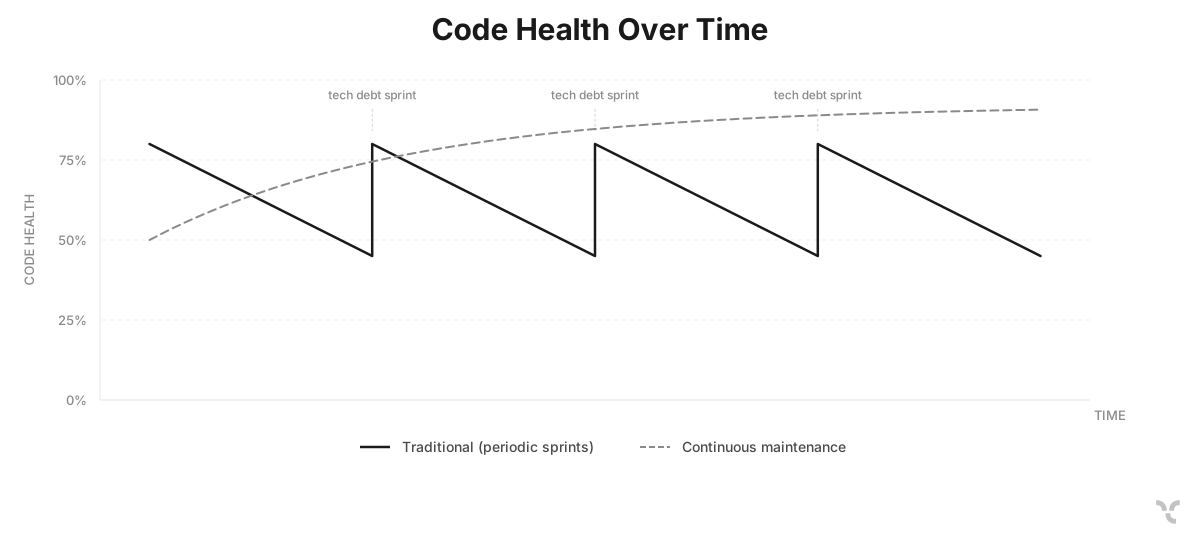
The key insight is that traditional maintenance creates a sawtooth pattern. Code health degrades between maintenance sprints, then improves briefly when the team focuses on it, then degrades again. Continuous maintenance flattens that curve by addressing issues as they appear.
This does not mean developers never touch maintenance work directly. Complex architectural refactors, major dependency upgrades, and design-level changes still require human judgment and dedicated engineering time. Continuous maintenance handles the high-volume, repeatable tasks so that when developers do focus on maintenance, they work on the problems that actually require their expertise.
Key Components of an Effective Code Maintenance Strategy
An effective continuous maintenance strategy combines automated tooling with clear processes. These are the five components that matter most.
1. Automated code review and quality checks. Every PR should pass through automated review before a human sees it. Static analysis tools catch style violations, type errors, and potential bugs. AI-powered review tools go further, analyzing logic, identifying edge cases, and checking for security patterns. Tembo's PR review automation runs a coding agent on every PR that checks for bugs, logic errors, security vulnerabilities, and performance issues, with inline comments on specific lines. This catches problems that static analysis alone would miss.
2. Dependency management and security scanning. With legacy code, outdated dependencies are the most common source of preventable security incidents. Your strategy needs automated dependency scanning on a regular cadence. Tools like Dependabot, Renovate, and Snyk handle version checking and PR creation. For broader security scanning that includes detection of hardcoded secrets, SQL injection patterns, and authentication flaws, Tembo's code scanning automations add a deeper layer of coverage by analyzing how dependency changes affect your application logic.
3. Test coverage monitoring. Maintenance without testing (especially automated testing!) is guesswork. Track coverage metrics not as a vanity number, but as an indicator of which code paths are unprotected. When coverage drops in a specific module after a refactor, that is an early warning that your changes may have unintended consequences. Integrate coverage checks into your CI pipeline so regressions surface immediately.
4. Documentation as a living artifact. Documentation that drifts from the actual codebase is worse than no documentation, because it actively misleads. Effective maintenance strategies treat docs as code: they are version-controlled, reviewed in PRs, and updated when the code they describe changes. Some teams automate this by triggering documentation updates whenever code in the corresponding module is modified.
5. Monitoring and error response workflows. The gap between "an error appeared" and "someone started fixing it" is where production incidents live. Continuous maintenance closes this gap by connecting monitoring tools to automated response workflows. When Sentry detects a new error or an error spike, an agent can analyze the stack trace, identify the likely root cause, generate a fix, and open a PR, all before a developer has finished reading the alert. This turns error response from a manual, interrupt-driven process into an automated pipeline.
Challenges in Continuous Code Maintenance
Adopting continuous maintenance is not free. These are the obstacles teams encounter most often, and how to address them.
Scaling across multiple repositories. Organizations with dozens or hundreds of repos face a coordination problem: applying consistent maintenance policies across all of them. A dependency update in a shared library may require coordinated changes across multiple downstream repos. Single-repo tools do not solve this. You need platforms that understand multi-repo relationships and can open coordinated PRs across your codebase.
Prioritizing what to maintain first. Not all maintenance work is equally valuable. Updating a dependency in a critical production service matters more than refactoring a test utility. Teams need a framework for scoring maintenance tasks by impact: how many users does this affect? What is the security risk? How much does this slow down development? Without prioritization, automation generates noise instead of value. A practical approach is to focus automated maintenance on the areas with the highest technical debt burden first and expand from there.
Avoiding automation fatigue. If every automated scan generates 50 PRs overnight, developers stop reviewing them. The goal is not maximum automation. It is useful automation that respects your team's review capacity. Configure maintenance automations to batch related changes, set reasonable thresholds for what triggers a PR versus what gets logged for later, and ensure automated PRs are small enough to review in minutes rather than hours.
Maintaining code quality in automated changes. Automated fixes must pass the same quality bar as human-authored code. This means automated changes go through your standard PR review process. The best automated maintenance tools submit their work as PRs with clear descriptions of what changed and why, let you reject or request modifications, and iterate based on feedback, the same workflow you use for human contributors.
Tools That Support Continuous Code Maintenance
The tooling landscape for code maintenance spans several categories. The right combination depends on your team's size, tech stack, and how much maintenance you want to automate.
Static analysis and linting. ESLint, Pylint, and SonarQube help to enforce coding standards and catch code quality issues at the syntax and pattern level. These are table stakes for any CI pipeline. They handle style enforcement, detect common anti-patterns, and ensure code follows your team's conventions. The limitation is that they operate on individual files without understanding broader application logic.
Dependency management. Dependabot (GitHub native), Renovate (open-source, multi-platform), and Snyk (security-focused) automate the process of detecting outdated packages and opening update PRs. Snyk adds vulnerability scanning that maps your dependency tree against known CVE databases.
Monitoring and observability. Sentry, Datadog, and Grafana provide the detection layer that feeds your maintenance workflow. Without visibility into what is breaking, degrading, or trending in the wrong direction, maintenance becomes guesswork.
AI coding agents for autonomous maintenance. This is the category that changes maintenance from a set of individual automated checks into a coordinated, continuous process. Tembo runs AI coding agents in the background to handle maintenance end-to-end: detecting issues through integrations with GitHub, Sentry, and Linear, analyzing the codebase in a sandboxed environment, generating fixes, and submitting PRs for review. The key difference from traditional CI tools is that these agents understand code context, not just patterns. They can analyze a Sentry error, trace it to the root cause across files, generate a targeted fix, and explain the change in the PR description.
Tembo supports scheduled and event-driven automations, so you can configure maintenance to match your team's workflow. Scheduled automations run on daily or weekly cadences for recurring tasks like dependency updates and security scans. Event-driven automations respond to webhooks from tools in your stack, triggering maintenance work the moment an issue is detected. The platform also provides pre-built automation templates for common maintenance tasks like PR reviews, code scanning, and technical debt reduction, each customizable to your codebase's specific needs.
Choosing your stack. Start with the fundamentals (linting, dependency scanning, monitoring), then layer in AI-powered automation for the tasks that consume the most developer time. The goal is not to replace every tool with an agent but to connect your existing tools into a continuous maintenance loop where detection, diagnosis, and resolution happen automatically for routine issues.
Conclusion
Continuous code maintenance is an investment in sustained development velocity. Software development has changed, and the teams that embed maintenance into their daily workflow, through automated scanning, event-driven responses, and scheduled upkeep, spend less time fighting fires and more time shipping features. The alternative is a codebase that gets harder to work with every month, where every new feature takes longer than the last because of accumulated debt.
The most effective approach combines traditional tools (static analysis, dependency scanning, monitoring) with AI coding agents that handle the coordination and execution of maintenance work autonomously. To see this in practice, start with Tembo's free tier, which includes a $10 one-time usage allowance on one repository. Set up a scheduled automation for one maintenance task, whether that is PR reviews, security scans, or dependency audits, and measure the impact on your team's maintenance backlog after 30 days. The teams that start now will be the ones shipping faster a year from now.
Run any coding agent in the cloud
Tembo agents execute tasks in secure cloud environments and return reviewable output. Use any agent or model, run in parallel, and keep humans in control.


