

Tembo vs T3 Code: Which Is Best in 2026?
Compare Tembo and T3 Code for AI coding: remote access, harnesses, automations, PR review, team analytics, pricing, and who should use each.

You want to use several coding agents, reach them from anywhere, and stop switching between separate apps. Both Tembo and T3 Code can help. So why pay for Tembo when T3 Code has remote connections and multiple harnesses too?
Choose Tembo if you want a shared engineering platform: managed agent environments, tasks from Slack and issue trackers, ready-made automations, and reporting on what your team ships. Choose T3 Code if you want a free, open-source interface for agents running on machines you control.
Remote access and harness choice are shared capabilities. The useful comparison is what happens around the agent: who runs the computers, how tasks arrive, how changes get reviewed, and how a team measures the results.
Jump to: Comparison table · Tembo review · T3 Code review · Hands-on checks · Head-to-head · Verdict
Tembo vs T3 Code at a glance
| What you are comparing | Tembo | T3 Code |
|---|---|---|
| Pricing | Pro: $60/month, up to five users | Free MIT-licensed software; bring agent access and a host |
| Best for | Teams delegating engineering work | Developers controlling agents on their own machines |
| Multiple harnesses | ✓ Integrated harnesses in QEMU VMs | ✓ Uses installed harnesses on your host |
| Remote work | ✓ Managed cloud sessions | ✓ T3 Connect, SSH, LAN, or Tailscale |
| Host provisioning | ✓ Managed environments, plus self-hosted options | You supply the host; T3 can set up its server over SSH |
| Slack, Linear, Jira, and Sentry workflows | ✓ Native integrations | Configurable webhook prompts and outside-agent MCP |
| Recurring and webhook tasks | ✓ Managed automations and engineering templates | ✓ Scheduled tasks and configurable webhook prompts |
| PR review and guided reading | ✓ Tembo Review, PR chat, Tour Mode | ✓ PR workflows, agent chat, and beta review guides |
| Git providers | GitHub, GitLab, Bitbucket | GitHub, GitLab, Bitbucket, and other hosts |
| Usage visibility | ✓ Tokens by model and teammate | ✓ Tokens, API-equivalent cost estimates, subscription limits |
| Reporting focus | ✓ Insights: created/merged PRs by teammate and repo | Usage across environments; linked PR status |
| Deployment control | Managed cloud or enterprise self-hosting | Run the open-source server on your hardware or VPS |
The T3 Code feature check uses v0.1.5, released October 29, 2026. Both products have free entry options; Tembo’s paid Pro plan is the price shown above.
Tembo review
Overview
Tembo is for engineering teams that want agents to take work from a request through to a reviewable change. It combines isolated development environments with native integrations, automations, code review, and team analytics. You can work interactively or delegate a task and come back when it is ready.
A teammate can ask for a fix in Slack, assign an issue in Linear, or trigger an investigation from Sentry. The context and output stay connected to the team's work instead of becoming another chat someone has to manage.
Strengths and tradeoffs
- Strengths: managed compute, native task integrations, reusable engineering automations, coordinated multi-repo changes, Tembo Review, and Insights.
- Tradeoffs: a paid service with usage costs and repository setup. For a solo developer who already has a reliable host and only needs an agent UI, some of that platform may be unnecessary.
Pricing and value
Tembo Pro starts at $60 per month for up to five users, including a $60 monthly usage allowance and integrations. Cloud compute and Tembo Gateway inference draw from it. With your own API keys or a supported subscription, inference is billed by the provider; cloud compute still uses your Tembo allowance. The value is the infrastructure and team workflow you get together, rather than just access to a different chat interface.
T3 Code review
Overview
T3 Code is an open-source control surface for coding agents. It uses harnesses such as Claude Code, Codex, Cursor, and OpenCode, with the accounts and subscriptions configured on the machine doing the work. Desktop, web, and mobile clients connect to those environments.
It also goes beyond a basic chat window. Source control features include PR creation, review actions, working on an existing PR, and beta review guides. Its Git support includes GitHub, GitLab, Bitbucket, and several other hosts.
In use
We launched v0.1.5, paired a browser, completed onboarding, and opened its task editor. The scheduler offered fixed-time, interval, and webhook modes. Our screenshot below shows an unsaved example; we did not run a coding task or connect a remote device.
Strengths and tradeoffs
- Strengths: free MIT-licensed software, multiple harnesses, mobile clients, remote connections, local control, scheduled tasks, and substantial Git tooling.
- Tradeoffs: you supply and maintain the host, provider setup, and project environment. Webhook connections need configuration, and you operate the host that runs the work.
Pricing and value
The T3 Code FAQ says the app is free; you still pay for agent access and any infrastructure you rent. As of this version, T3 Connect allows three linked machines on a free account, with higher limits through paid T3 Chat plans. For an individual with an existing workstation or VPS, the extra software cost can be zero.
What we tested
We launched T3 Code v0.1.5, paired the local browser, completed onboarding, and opened the Scheduled tasks editor. We entered an example prompt and confirmed the editor offered fixed-time, interval, and webhook modes. We cancelled the draft without saving or running it.
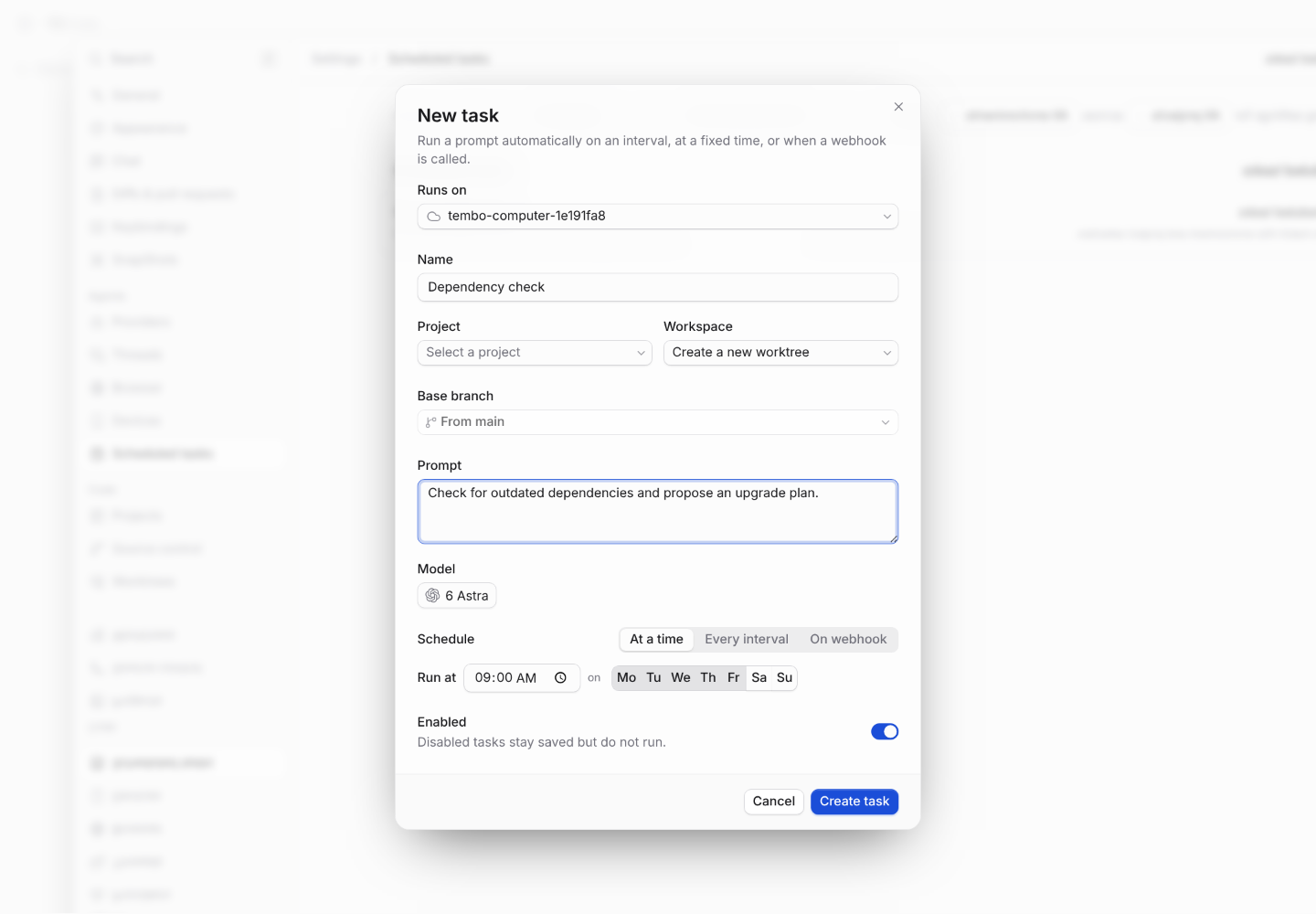
Our local check on October 30, 2026: an unsaved example task in T3 Code's scheduler.
We also used Tembo's Slack-to-PR workflow to prepare these comparison posts and checked their desktop and mobile previews. That is evidence of the task handoff, not a controlled coding benchmark. We did not run identical coding tasks on both platforms or test a live T3 Connect tunnel; remote behavior is based on the versioned guide linked below.
Head-to-head
Remote access and harnesses: both deliver
T3 Code's remote guide supports T3 Connect, direct network pairing, and SSH connections. You can put its server on a VPS and use it from a phone or another computer. It is not restricted to running agents on your laptop.
Tembo supplies managed cloud environments where supported harnesses work against your repositories. Your laptop can disconnect while the cloud machine continues working.
The choice is ownership: use T3 Code to reach a host you run; use Tembo to get the host and the agent workflow together. We would not choose between them on harness count or remote access alone.
Tasks from the rest of the team: Tembo
Tembo's integrations make Slack messages, Linear assignments, Jira workflows, and Sentry errors entry points for engineering work. An agent can use the connected context and bring results back to the conversation.
T3 Code can receive work through webhook tasks and MCP access for outside agents. You can connect other systems to it. Tembo's advantage is having those team integrations packaged and maintained as part of the platform.
Tembo wins for a team that wants to assign work through existing tools without owning the connecting services.
Scheduled work: T3 Code has it; Tembo adds ready-made workflows
T3 Code supports recurring tasks and webhook-triggered prompts. Its editor can target an environment and project, while webhook configuration supports payload templates and filters. Public webhook URLs require a T3 Connect managed tunnel. A PR event can therefore start an agent review; the execution host must be running.
Tembo's automation catalog supplies engineering workflows for dependency upgrades, incident triage, reviews, security fixes, and documentation maintenance. Schedules and tool events run those workflows in managed environments.
Choose T3 Code for custom scheduled prompts on your own host. Tembo wins when you want reusable team automations with native tool connections and managed execution.
Reviewing code: compare the whole experience
Both products support reviewing PRs and asking an agent to work on a change. T3 Code's beta guides organize a PR into stops through related changes; Tembo's Tour Mode groups files and explains the change with risk signals. Guided review is a shared idea, not a Tembo-only feature.
Tembo Review brings that experience into the same platform as delegated work and automated reviews that run project checks. T3 Code lets you review and act through the accounts and environments connected to its server.
There is no evidence here for a universal review-quality winner. Tembo is the stronger fit if you want reviews integrated with an organization-wide agent workflow; T3 Code is worth trying if you already do that work through your own environments.
Understanding team results: Tembo
T3 Code's Usage page reports tokens, estimated API-equivalent costs, and subscription limits across connected environments. Those cost estimates are not your subscription bill. Its PR tools also track linked PR status, so it does more than count prompts.
Tembo Insights also connects agent sessions to created and merged PRs, with adoption and contribution broken down by teammate and repository. That answers a different question: what is your organization actually shipping with agents?
Choose Tembo when you need those teammate and repository rollups. They connect agent usage to accepted changes in a view built for an engineering team.
Hosting and value: depends on who operates it
T3 Code wins on software price and source-level control. You can run or modify its MIT-licensed server yourself. You also own its host, updates, availability, and credentials.
Tembo offers managed cloud execution plus self-hosting. It also supports coordinated PRs across repositories for changes that span services.
T3 Code can link several PRs to one thread, including PRs from other repositories on the same host. Its beta linked environments also let agents delegate work between machines. Multi-repo context and remote delegation are not exclusive to Tembo; Tembo supplies the managed environments and native team integrations around that work.
T3 Code is better value if your own machines and provider accounts already cover the job. Tembo is better value when your team needs the managed environments, integrations, and shared reporting as well.
Which should you choose?
Choose Tembo if you want developers and teammates to delegate work from shared tools, run maintenance across repositories, review the results, and measure adoption. It is our recommendation for a team buying an engineering platform it can use without building the surrounding services.
Choose T3 Code if you want a free, open-source app for your own agents, like controlling your host and credentials, and value desktop, browser, and mobile access. You may find its built-in scheduling and Git workflows cover everything you need.
Try Tembo with a real issue, check current Tembo pricing, or install T3 Code. If you are choosing sandbox infrastructure rather than an agent interface, see Tembo vs Boat.
Frequently asked questions
Does T3 Code support remote agents and multiple harnesses?
Yes. It connects to agents on your own machines, including remote servers, and supports multiple harnesses. Tembo also supports remote execution and harness choice, with managed environments and team workflows around them.
Does T3 Code support schedules, webhooks, and PR reviews?
Yes. Version 0.1.5 includes scheduled tasks, webhook prompts, PR workflows, and beta review guides. Tembo's additional value is its native business-tool integrations, ready-made engineering automations, managed execution, and team delivery analytics.
Is T3 Code free?
The software is free under the MIT license. Agent subscriptions or API usage and any rented host still cost money. Check current T3 Connect machine limits if you plan to connect several environments.
Is self-hosting unique to Tembo?
No. You can host T3 Code yourself. Tembo offers an enterprise deployment of its full platform alongside a managed cloud service; the relevant distinction is what you operate and which team workflows you need.
Run any coding agent in the cloud
Tembo agents execute tasks in secure cloud environments and return reviewable output. Use any agent or model, run in parallel, and keep humans in control.


